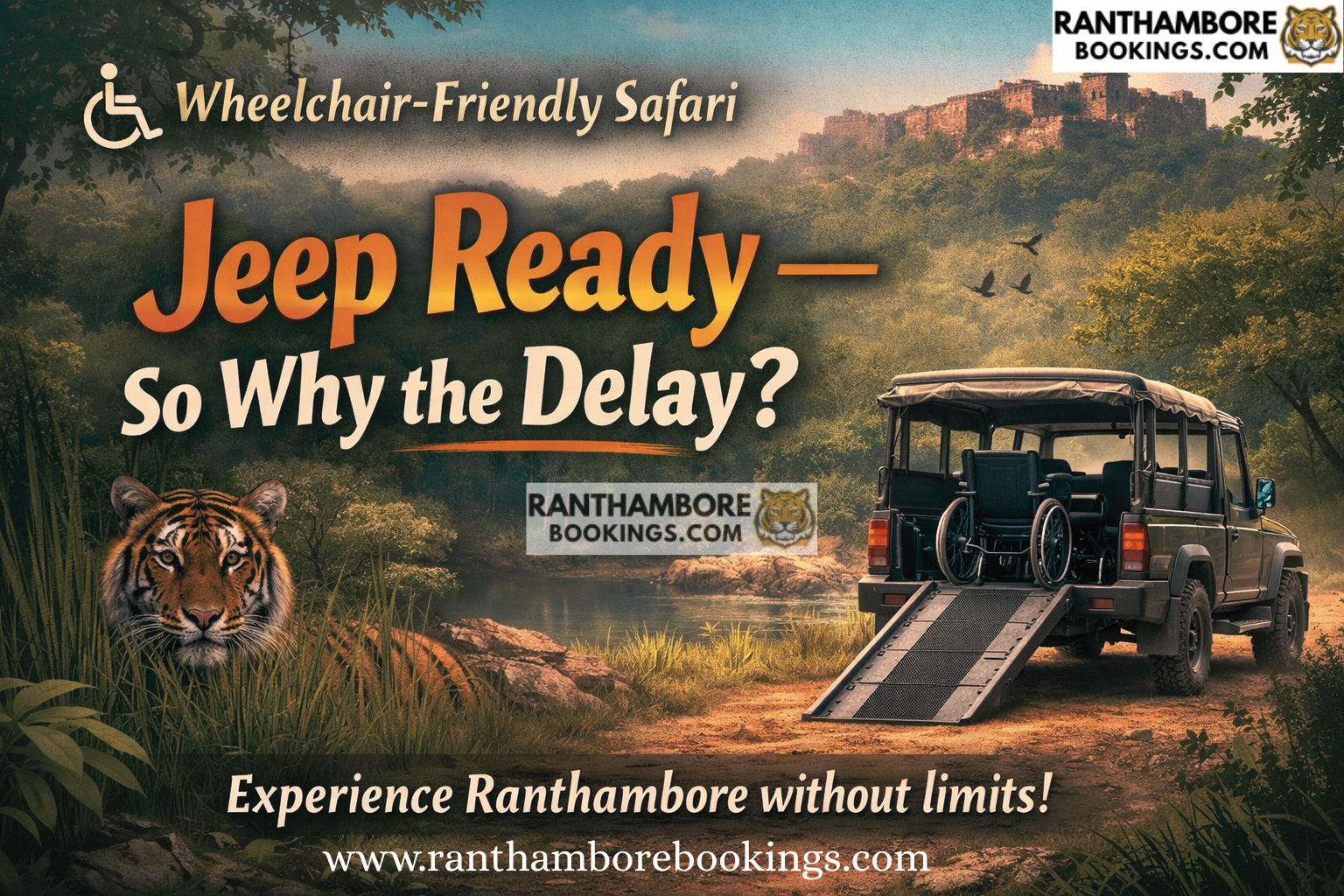
Near the safari vehicle holding area at Ranthambore Tiger Reserve in Rajasthan, a specially modified Gipsy jeep stands ready. Fitted with a powered ramp, wheelchair locking system, foldable seating, and reinforced safety belts, it is engineered specifically for rugged forest tracks and independent wheelchair access. This is India’s first Wheelchair Safari Jeep Ready vehicle designed for a tiger reserve. And it has never carried a visitor into the forest. For wheelchair users visiting Ranthambore, this vehicle represents hope — the hope of finally experiencing one of India’s most iconic tiger safaris independently and safely.
A Historical Overview of Ranthambore Tiger Reserve
Ranthambore Tiger Reserve, spanning over 392 square kilometres, is one of India’s largest and most famous tiger reserves. The park is located in the Sawai Madhopur district of Rajasthan and is home to a thriving population of Bengal tigers, leopards, sloth bears, and over 300 species of birds. Its landscape combines dense forests, dry deciduous regions, rocky outcrops, and the historical Ranthambore Fort.
Each year, thousands of domestic and international tourists visit Ranthambore to witness the majestic Bengal tiger in its natural habitat. Safaris are the highlight of the experience, offering opportunities for wildlife photography, nature observation, and ecotourism.
However, for persons with disabilities, accessing this experience has historically been a challenge. The standard safari infrastructure was not designed with mobility impairments in mind. This led to a significant portion of tourists being unable to participate in the very experience that Ranthambore is famous for.
The Accessibility Gap in Indian Wildlife Tourism
Accessible tourism has been a long-standing challenge in India. While cities and public spaces have gradually improved accessibility, wildlife tourism — especially tiger reserves and national parks — still lags.
Key barriers include:
- Safari vehicles are designed without ramps or wheelchair space.
- Uneven forest tracks are unsuitable for wheelchair travel.
- Lack of trained staff to support mobility-impaired visitors.
- Limited awareness among authorities regarding disability rights and accessibility requirements.
In this context, the creation of a wheelchair-accessible safari jeep at Ranthambore was a landmark initiative. It directly addresses the question, “Can wheelchair users do tiger safaris in Ranthambore?” For years, the answer was no — now it could be yes, if administrative permissions allow.
Learn more about booking Ranthambore safaris for all tourists.
The 2020 Government Directive: Making Tourism Inclusive
On December 5, 2020, the Rajasthan Forest Department issued a directive under the Rights of Persons with Disabilities Act, 2016, mandating all national parks, wildlife sanctuaries, and zoos to introduce disabled-friendly tourism vehicles.
The directive outlined that:
- Vehicles must allow independent wheelchair access.
- Safety mechanisms such as seat belts and stabilisers should be included.
- Structural barriers preventing participation in safaris must be removed.
This move was part of a broader push towards inclusive tourism in India, ensuring that persons with disabilities could participate in nature and wildlife experiences without compromise or assistance.
Ranthambore, being a globally recognised tiger habitat, had a unique opportunity to pioneer this initiative in India. The reserve could have become the first wheelchair-friendly tiger safari destination, inspiring other national parks like Jim Corbett, Kanha, Bandhavgarh, Kaziranga, and Pench.
For those curious about Ranthambore’s broader conservation efforts, read about the recent tiger relocation project.
Balendu Singh: Turning Policy Into Action
Balendu Singh, a hotelier in Ranthambore and former honorary wildlife warden, recognised the gap in accessible tourism firsthand. Being a person with a disability, Singh understood the challenges faced by wheelchair users and decided to act.
After studying wheelchair-accessible safari vehicles used abroad, Singh conceptualised and developed a modified Gipsy jeep suitable for the jungle terrain of Ranthambore. His goals were clear:
- Enable independent access without assistance.
- Ensure safety and stability on uneven forest tracks.
- Maintain comfort and dignity for all visitors.
This vehicle was not merely a retrofit; it was designed from the ground up to address accessibility needs while being fully functional for tiger safari operations.
Features of the Wheelchair Safari Jeep
The wheelchair-accessible Gipsy jeep includes:
- Electrically operated ramp for independent entry.
- A wheelchair anchoring and stabilisation system to prevent movement during travel.
- Flexible seating layout allowing the wheelchair to be positioned safely.
- Option to remain in the wheelchair or transfer to a secured seat.
- Reinforced seat belts and interior layout engineered for uneven tracks.
Every detail was engineered to meet international standards of accessible safari vehicles while accommodating Ranthambore’s specific jungle conditions.
For planning a trip, check the Ranthambore safari booking platform to understand safari rules, timings, and vehicle availability.
Inspections and Official Recognition
The vehicle underwent inspections and trial runs by authorities, including:
- The Disability Commissioner
- Chief Wildlife Warden
- Forest Department officials
Officials recognised the importance of this initiative, acknowledging its legal and social significance. The jeep could operate outside the standard safari vehicle roster due to its specialised design.
Despite approvals, the final operational permit has not been granted. People searching for a wheelchair-accessible safari jeep in Ranthambore still find a vehicle that exists but cannot be used.
While the park strictly enforces regulations like the mobile phone ban, accessibility measures remain unimplemented.
The Legal Framework: Rights of Persons With Disabilities Act, 2016
The Rights of Persons With Disabilities Act, 2016, mandates accessibility across public services, tourism, transport, and education. In theory, this means that safari tourism at Ranthambore must provide equal access to persons with disabilities.
The gap between policy and practice is evident:
- The law mandates accessibility.
- A citizen (Balendu Singh) builds the solution.
- Authorities inspect and approve.
- Implementation stalls due to administrative delays.
This case highlights how infrastructure, legislation, and citizen action can align, yet bureaucracy still prevents tangible outcomes.
The Tourist Experience for Wheelchair Users
For most visitors, a Ranthambore safari is a thrilling, unforgettable experience.
For wheelchair users, it has traditionally been a disappointment. They face:
- Physical barriers at entry points.
- Standard safari jeeps that cannot accommodate wheelchairs.
- Lack of independent access, requiring assistance or lifts.
This wheelchair-accessible jeep solves all of these challenges, allowing visitors to roll in independently, secure their wheelchairs, and enjoy the safari without compromise.
Broader Implications for Inclusive Tourism in India
If this initiative becomes operational, Ranthambore would set a precedent for inclusive wildlife tourism in India.
Other tiger reserves and national parks could adopt similar models, expanding accessibility across the country. This would:
- Encourage responsible tourism.
- Boost visitor numbers among disabled travellers.
- Promote India as a global leader in accessible wildlife experiences.
Globally, accessible safaris are standard in parks across Africa and Southeast Asia. India is poised to join this movement — once the administrative hurdles are cleared.
More Than Just a Jeep
For Balendu Singh, this vehicle represents:
- Independence without assistance.
- Dignity without compromise.
- Inclusion without special treatment.
The forest routes are ready. The vehicle is ready. The law supports accessibility. Visitors are waiting.
The only missing element is the administrative approval to bring it into the reserve.
Planning Your Trip to Ranthambore
Visitors can plan their safari experience using the Ranthambore booking platform. Tips for all tourists:
- Check availability and safari timings.
- Follow park rules, including the mobile phone ban.
- Respect wildlife regulations and safety measures.
- For wheelchair users, confirm accessibility features in advance.
This ensures a smooth, memorable, and safe wildlife experience for everyone.
Conclusion: When Will Inclusion Finally Arrive?
The wheelchair-accessible safari jeep at Ranthambore stands as a symbol of inclusive wildlife tourism paused at the gate.
Once allowed to operate, it will answer a long-standing question:
“Is the Ranthambore safari accessible for disabled visitors?”
The day it enters the tiger reserve, India will take a significant step toward inclusive and accessible wildlife tourism.
Plan your visit and support this initiative through the Ranthambore safari bookings.
Ranthambore’s wheelchair-accessible safari jeep is a specially modified Gipsy designed to allow persons with disabilities to participate in a tiger safari comfortably and independently. It includes a powered ramp, a wheelchair locking system, foldable seating, reinforced safety belts, and a layout suited for rugged jungle tracks.
The vehicle was developed in response to the Rajasthan Forest Department’s 2020 directive under the Rights of Persons with Disabilities Act, 2016, which called for disability-friendly tourism vehicles in national parks. The aim was to remove physical barriers and make jungle safaris accessible to visitors with mobility impairments.
The safari jeep was conceptualised and developed by Balendu Singh, a Ranthambore hotelier and former honorary wildlife warden. Being a person with a disability himself, he recognised the need for an accessible safari vehicle after seeing many disabled tourists unable to participate in the Ranthambore tiger safari.
According to Singh, the vehicle has undergone inspections and trial runs and has been acknowledged by officials, including the Disability Commissioner, Chief Wildlife Warden, and forest department authorities. However, despite these clearances, the final operational permit to enter the tiger reserve has not been issued.
If operational, this jeep would make Ranthambore the first tiger reserve in India to offer a wheelchair-friendly safari experience. It could set a precedent for other national parks like Jim Corbett, Kanha, Bandhavgarh, Kaziranga, and Pench to introduce inclusive safari infrastructure.
There is no technical or safety issue with the vehicle. The delay is administrative. While policy support, infrastructure, and tourist needs all exist, the final permission required to allow the jeep into the forest has not yet been granted, leaving the initiative stalled in practice.