
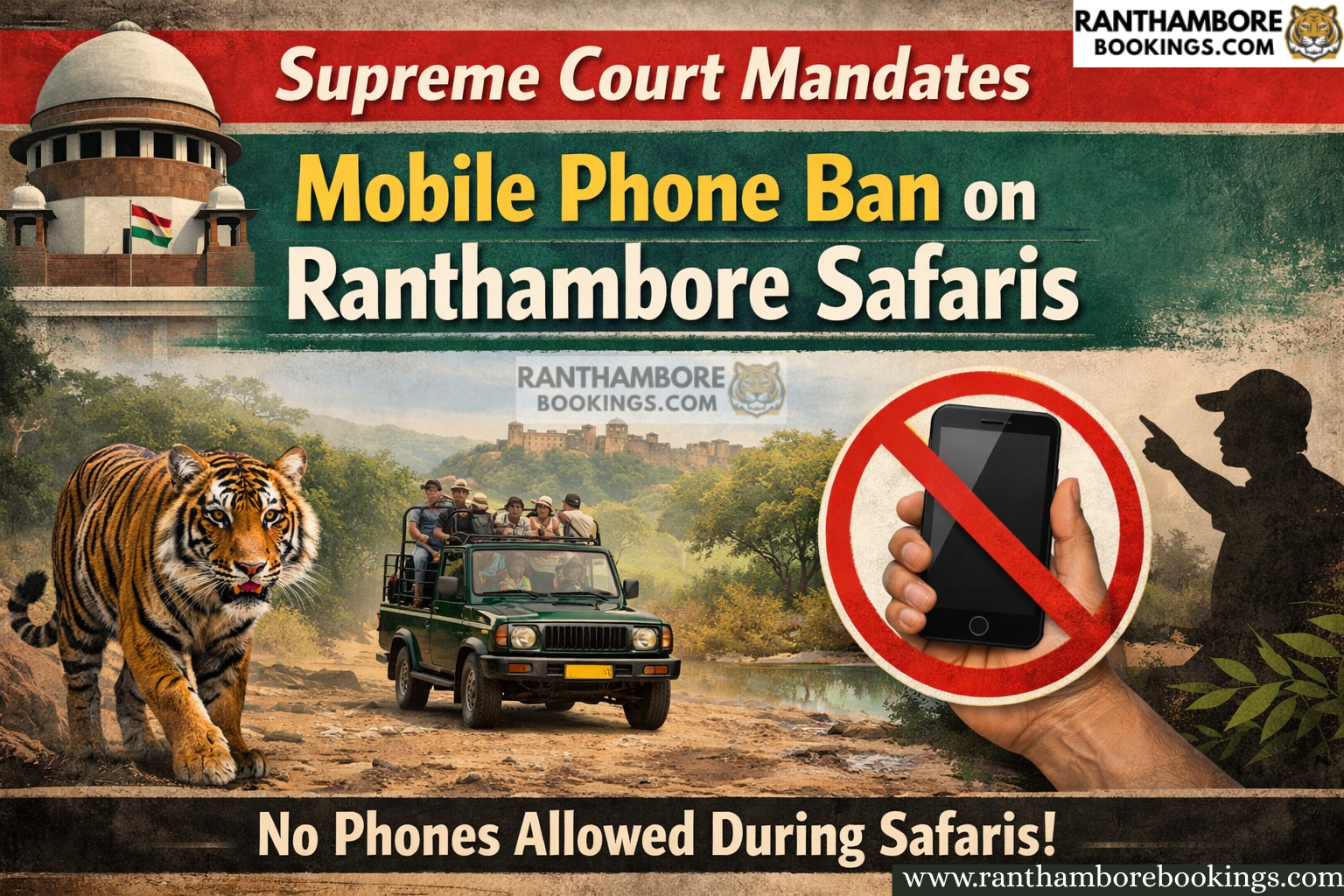
In a decisive move to strengthen wildlife protection and promote responsible tourism, mobile phone use has been prohibited during safari rides in Ranthambore National Park following directives from the Supreme Court of India. The Forest Department has enforced this rule to minimize human disturbance in one of the country’s most important tiger habitats and to restore the natural quiet of the forest.
Ranthambore, celebrated for its thriving tiger population, ancient ruins, scenic lakes, and dry deciduous forests, has long been a magnet for wildlife lovers and photographers. In recent years, however, safari experiences have increasingly turned into opportunities for filming reels, taking selfies, and capturing viral videos. Authorities observed that this shift in tourist behaviour was interfering with wildlife movement and compromising the true spirit of a jungle safari.
This new regulation aims to reset that balance and bring the focus back to mindful wildlife observation and conservation-first tourism.
What the Order States
Visitors entering Ranthambore for safari tours are no longer permitted to use mobile phones inside the park.
Acting on Supreme Court guidelines, the Forest Department has introduced a total restriction on mobile phone usage during safaris. The order applies to all visitors, safari guides, and vehicle drivers without exception.
Authorities clarified that the purpose is not merely to curb photography or social media usage. The core objective is to prevent:
- Noise pollution
- Vehicle crowding during animal sightings
- Unsafe tourist behaviour
- Disturbance to animals in their natural habitat
The order reinforces that wildlife reserves are conservation zones, not entertainment spaces.
Why This Ban Became Essential
Deputy Conservator of Forests (Tourism), Ranthambore Tiger Project, Sanjeev Sharma, noted that the decision is aimed at safeguarding wildlife, avoiding disruption to natural animal behaviour, and preserving the serene forest atmosphere.
He highlighted that the Supreme Court has instructed authorities to stop activities such as:
- Loud noises
- Recording reels and videos
- Taking selfies near animals
- Moving too close to wildlife during sightings
In many instances, safari jeeps clustered around animals so tourists could capture better footage. This created stress for wildlife and hazards for visitors. Tigers and other animals were often forced to change their routes or retreat into dense forest areas due to human interference.
The Impact of Mobile Phones on Wildlife Movement
Officials reported that mobile phones often prompted tourists to pressure drivers to approach animals for photos and videos. This behaviour had several negative consequences:
- Several vehicles assembled at a single sighting point
- Obstruction of natural animal pathways
- Excessive noise and chaos
- Higher chances of unsafe encounters between humans and wildlife
Such interference alters animal behaviour patterns and weakens ongoing conservation efforts in Ranthambore. Tigers, leopards, deer, sloth bears, and birds depend on predictable movement routes, which were increasingly disrupted by crowded vehicles.
Why This Time the Rule Will Hold
Previously, a similar restriction applied to safari drivers and guides, but was rolled back after objections and protests.
Now, backed directly by the Supreme Court’s authority, the rule applies uniformly to tourists, guides, and drivers, making adherence compulsory. Forest officials have been empowered to strictly monitor compliance and take action against violators.
Encouraging Responsible Wildlife Tourism
This initiative is being welcomed as a meaningful step toward ethical and responsible wildlife tourism in India.
Freed from mobile distractions, visitors can:
- Watch animals calmly and patiently.
- Keep a respectful distance from wildlife.
- Absorb the forest’s natural silence.e
- Appreciate wildlife without interference.ce
A safari is meant to be experienced with awareness — not through a phone screen. This rule helps restore that original purpose.
What Visitors Should Know Before Their Safari
Tourists planning a Ranthambore safari should keep the following points in mind:
- Mobile phones cannot be used during the safari.
- Dedicated cameras and DSLRs remain permitted.
- Checks will be carried out at entry gates and along routes.
- Violations may attract penalties or cancellation of safari permissions.
- Cooperation with guides and forest staff is mandatory.
Visitors are encouraged to be fully present and respectful while exploring the park.
For updated safari guidelines, zones, and bookings, visitors can refer to the official Ranthambore booking platform at Ranthambore Bookings.
Those interested in combining their wildlife trip with a river safari experience can also explore Chambal Safari Booking for a unique add-on to their itinerary.
How This Improves the Safari Experience
Wildlife experts believe this decision will significantly enhance the safari experience. Without the distraction of phones:
- Tourists pay more attention to animal behaviour.
- The forest remains quieter and more natural.
- Wildlife sightings become less stressful for animals
- The overall experience becomes immersive and educational.
The absence of phones brings back the authentic charm of a jungle safari.
Broader Message for Wildlife Tourism in India
This decision from Ranthambore may set an example for other national parks and tiger reserves across India. Protected areas are meant for conservation, learning, and silent observation — not social media content creation.
The mobile phone ban sends a strong message that wildlife tourism must align with conservation goals.
FAQs – Ranthambore Safari Mobile Phone Restriction
1. Is mobile phone usage fully prohibited during safaris?
Yes, using mobile phones during safari rides is not allowed under Supreme Court orders.
2. Can I keep my phone with me if it’s switched off?
You may carry it, but using it at any time during the safari is not permitted.
3. Are DSLR or digital cameras allowed?
Yes, cameras are allowed. The restriction applies only to mobile phones.
4. What is the reason behind this rule?
To minimize wildlife disturbance, avoid vehicle congestion at sightings, and create a safer, more peaceful safari environment.
5. Does this apply to safari staff too?
Yes, tourists, guides, and drivers must all follow this rule.
6. What action will be taken for violations?
Forest officials can impose fines or other strict measures for non-compliance.
7. Will this improve the safari experience?
Yes, visitors can enjoy a more peaceful and authentic encounter with wildlife.
Conclusion
The mobile phone ban in Ranthambore is more than a regulation — it is a reminder that wildlife tourism is rooted in respect, patience, and conservation. By limiting distractions and encouraging mindful observation, Ranthambore National Park is taking a bold step toward preserving its wildlife and offering visitors a truly natural safari experience.